• Skip to primary navigation
  • Skip to main content
Progressive Gauge

Progressive Gauge

Media and Research

  • Home
  • About
  • Blog
  • Projects, Samples and Items
  • Video
  • Contact Jack
  • Show Search
Hide Search

Jack Vaughan

Tech segments merge and fork

September 15, 2022 By Jack Vaughan

Source ID
Source: IDC

The Skeptical Examiner. Tech Industry segments merge and fork in generally obscure ways. That can be driven arbitrarily by the categorization strategies that work for analyst groups like Gartner or IDC, but it’s also driven by the fact that technology buyers don’t live in categories convenient for marketers.

Among vendors’ deflection strategies in interviews is this: “You are comparing apples and oranges.” The implication: They have no competition.
No competition if the world is in neat compartments.

In the fruit section of any supermarket you will find people grabbing apples, oranges, blueberries, bananas; I’ve never seen anyone grab a cumquat. And tech buying can mirror this wanton buyer promiscuousness.

That occurs today while looking at IDC’s Market Glance that looks at the High Performance and Performance Intensive Computing sectors. The sets and subsets thereof are subjective and various … and often collide.

The cursory viewer may be surprised by the extent to which Nvidia, and IBM compete here and there. That says something about IBM’s challenges, which, obviously, come from more directions than just Nvidia.

On the Nvidia side, it tees up a question as to whether or not the chip and tools maker can support multiple efforts successfully, as it looks to break out of the gamer-crypto space, and to thrive in the new vistas of AI.

IBM’s focus on AI, which arguably seeded the wide renewed interest in the area, seems back-burner stuff for now – as it dims down the hype machine that was Watson.

Is ‘AI’ another name for high-performance computing?

I know the Nvidia/IBM angle on this IDC chart (above and below) surprised me. As one wag said: Check with your ophthalmologist before viewing it. – J.V.


.@IDC‘s Market Glance for Performance Intensive Computing. The convergence of HPC w/ AI, Big Data, Data Analytics, and Quantum Computing brings consolidation of infrastructure bringing decades of HPC’s best practices into the forefront to achieve optimal price/performance! pic.twitter.com/N6r5c0m2F6

— Matt Eastwood (@matteastwood) September 13, 2022
Sandia researcher pursues programming tricks to improve quantum computing’s chances

August 8, 2022 By Jack Vaughan

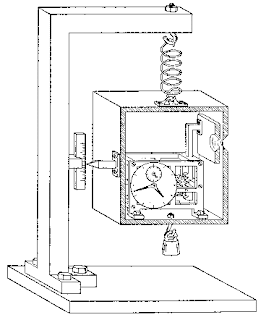
The Photon Box (1920s)

A grand sampling of today’s quantum movers and shakers shows many come from physics depts, R&D equipment makers, and the like, and that should remain the case for some time. This is one among many clues indicating the quantum computing industry is still struggling to be born. One foot is very much in the labs where quantum physics research has been going on for 10s of years.

A lot of work going on now has to do with moving particles and waves in ways that forward knowledge of the underlying quantum aspects of nature. It’s the stuff of headlines describing breakthroughs in Science and Nature magazines, as well as Nobel prizes. Manipulating things subatomic – it’s still not quite commonplace activity.

A news release from Sandia National Labs provides a glimpse into what goes on as researchers strive to scale-up quantum computing beyond the original test beds. From Sandia comes word that the Dept of Energy Office of Science has conferred a five-year Early Career Research Program Award grant to Timothy Proctor to improve the quantum computer programs now being devised at the honored research labs. A look at Proctor’s work discloses some of the friction points with which ‘quantumists’ must deal.

Proctor came to Sandia via Leeds University, where he explored a variety of techniques for creating computational quantum gates. A lot of that work has to do with creating operating system software that manages new types of hardware and communications. Error correction, boot order, and other operational traits that were fairly suitably solved some time ago in classical computing are still frontier undertakings for the quantum kind.

These days, he is looking at how commands are arranged and structured and what effect different approaches have on computing accuracy. That use case, in fact, is one of the key ones that fledgling quantum software houses are pursuing. Not surprisingly, comparing results on highly divergent quantum computing types is the first order of business for many who are just now dipping toes in the water.

As part of their public debates on physics in the 1920s Einstein and Bohrs did thought experiments. After all, there was no apparatus to separate, observe and manipulate atomic and sub-atomic particles. So, they used their minds. Laboratory rigs accomplish those experiments today – but the scale does not yet match the scale where quantum computing dependably scales beyond today’s best systems. When will that change? Work like Proctor’s algorithmic efforts will yield clues. – Jack Vaughan

Related
https://newsreleases.sandia.gov/proctor_award/
https://qpl.sandia.gov


Gauge Taking – Random notes on Claude Shannon

May 31, 2022 By Jack Vaughan

From Shannon’s Relays paper

[May 31, 2022] – I recently watched a documentary on the life of Claude Shannon. “The Bit Player” is a worthwhile piece on the originator of information theory. This caused me to retrieve an Obituary/Appreciation I wrote on his passing in February of 2001. Here I present some of the appreciation part.

Shannon was born in Petoskey, Mich., and grew up in Gaylord, Mich. He worked as a messenger for Western Union while in Gaylord High School, and attended college at MIT, where he was a member of Tau Beta Pi.

His paper, “A Symbolic Analysis of Relay and Switching Circuits,” which led to a long association with Bell Laboratories, laid out Shannon’s theories on the relationship of symbolic logic and relay circuits.

While at Bell Labs, Shannon wrote the landmark “The Mathematical Theory of Communication.” The information content of a message, he theorized, consists simply of the number of 1’s and 0’s it takes to transmit it. In a real sense, Shannon conceived of the “bit” that is now so widely used to represent data.

Shannon’s work led to many inventions used by both technology developers and end users. His theories can truly be described as pervasive today.

When I was young, Shannon’s work was a tough nut to crack, but it certainly was intriguing. As a high school boy, I was interested in the future — maybe more so than now, when I live and breathe and work in what that future became. Grappling with Shannon’s basic information theories was part of my education about the future.

Growing up in a Wisconsin city across the lake from Shannon’s birthplace, I tried to plow through the town library as best I could. I wanted to learn about computers, automation, and the combination of the two that was known in those days (the 1960s) as cybermation.* I discovered for myself — by chance, really — that the fundamental elements of those ideas were Shannon’s inventions.

Much of his greatest work revolved around defining information in relation to “noise,” the latter phenomenon being quite familiar to anyone who often tried desperately to home in on radio signals before digital communication filters came into being. I came to appreciate that aspect of Shannon’s work later on when, as a journalist, I had the opportunity to learn and write about digital signal processing.

Day and night, data, messages, music, and more swirls around us — all made possible to some extent by the idea of communicating electronically in 1’s and 0’s. It is something to think that a Western Union messenger could have conceived of this new world.

~~~~~~~~~~~~~~~~~

Postscript: Of course, Shannon did not envisage or invent PacMan or Puff Daddy MP3s – tho the documentary shows him to be a great fan of shellac jazz. He imagined the river for others to sail. This conjures the words of Herbert Kroemer, inventor of heterostructures that changed evolution of ICs and commercial optics. “A pendulum … goes back and forth from science to applications. Science creates applications … [they] stimulate new science-it’s not one way or the other,” Kroemer said in a Nobelist interview.

Now read the rest of the story –  Digital pioneer Claude Shannon dead at 84 – Computerworld – Feb 28, 2001

~~~~~~~~~~~~~~~~~

* I think we meant ‘cybernetics’.

Benedict Evans on Steps to the Future

April 16, 2022 By Jack Vaughan

[April 16, 2022] – Had the great good pleasure to sit in on a closing keynote at IDC Directions last month. It was led by Benedict Evans. Primarily he discussed Web 3 and The Metaverse – two areas that now vie for attention in the daily cauldron called high technology.

Who is Benedict Evans? A very witty London-based independent analyst who worked with a16z, NBC Universal and others. He has a thoughtful blog comprising essays, and a nifty email newsletter. And his hand is firmly on the pulse of The Next Big Thing.

There are always new upswelling technologies, shifting about like tectonic plates, as Evans’ presentation makes clear. Some will sputter, some will morph, and some will succeed — though few will thrive outright in the way that the PC and the smartphone thrived.

Evans outlines the major differences for the two presently vying Next Big Things: Web 3 and The Metaverse. The former is a new form of data and compute distribution heavily reliant on self-governing subnetworks based on blockchain. Its potential is not as a mere cryptocurrency exchange but as a wide spanning platform.

The blockchain underpinning is key to Web 3.0. It, said Evans, is: “a vision of an open source distributed virtualized computing system in which anybody can contribute, anybody can connect and all of the participants have some share of governance.”

Meanwhile the latter Next Big Thing candidate – the metaverse — is a way of saying that “VR isn’t just about goggles to play games, or do remote surgery … instead, this might be the next universal platform after smartphones.”

Evans points out these are new morphs of former technologies … or as he puts it:

Both of these in a sense are terms that rebrand, re conceptualize, or re imagine some ideas that have been around for a while.

Thus, the two platforms bring together individual techs a’ percolating, at least in the VC community dream.
The Metaverse thesis is the simpler of the two, he said,

VR and AR become the next universal device after smartphones. They break out of games — they break out far beyond games.

Yet, with the Metaverse, Evans said, there is a hurdle it may not vault. That is due to the case that electronic gaming remains a small market in comparison to the markets for PCs or smartphones. I suppose a new generation raised on these things may expand, and thus expand the potential of the Metaverse. Then too, phenomena like Roblox could combine aspects of blockchain-imbued Web 3 community and Metaversian components.

The point he raises on mitigating the Metaverse’s future – which I’d amend to include Web 3, or What Have You — is that it is not so much about whether the technology gets better, but whether,

If it does, who will care? And, will this break out and become a universal product?

There is no future except in use cases, as the saying goes.

My reflection on Evans’ treatise holds that, for today’s exciting assortment of new technologies (IoT, digital twins, ML, Edge, blockchain, quantum computing) to glom into something new and take hold, good large-scale use cases will need to be imagined, created, and promoted.

My experience speaking with chip builders focused on ML on the IoT edge tells me that they are working on this. Smart speakers seem closest to scaling – FitBits less so. Digital Twin makers as well are looking for large markets, but highly vertical uses seem to diffuse their chances there, and the are less likely to find the mass consumer market swath, but it’s not impossible.

*****

Besides being the first chance to get out of the house and to a conference, covering Edge Computing, IDC Directions 2022 in Boston’s Seaport District was also a nice return to something I’ve always enjoyed: the keynote on the future. Huzzah to Evans and IDC! Such Think Pieces were once de rigueur for some events but less so since everyone is in such a damn hurry. Evans’ critique was compelling, and I think his presentation usefully crystallizes constructive modes of technology analysis. Truly thought leading.

RELATED
Ben Evans Site and Presentation https://www.ben-evans.com/presentations
IDC Directions Site and Video Replay https://www.idc.com/events/directions/proceedings
Progressive Gauge Podcast Metaverse Ruminations https://progressivegauge.com/2022/01/31/progressive-podcast-digital-twins-meet-the-metaverse/


Will cloud hyperscalers react as Edge erupts?

March 31, 2022 By Jack Vaughan

When first there shook the decentralization tsunami of client-server computing, the mainframers responded successfully – well, IBM anyway. Some hemming and hawing, of course. But the IBM PC was a pivotal instrument of client-server’s move away from the domination of centralized mainframe-based computing.

But a tsunami finally hits a wall. After that, the tsunami energy reflects-back to the open ocean. When that happened (when client-server rolled over to cloud), IBM was busy promoting Watson AI. Big Blue had a heap of trouble when the elastic wave of centralization surged backwards – taking the name “cloud computing”.

The company cannot claim to an adequate response to cloud – it bought SoftLayer; it bought Cloudant; it bought RedHat. It still doesn’t have a cloud.

Its lunging stumbles are regularly chronicled by Charles Fitzgerald, who I had the good pleasure to speak with for a recent story I did for Venture Beat. Fitzgerald, a Seattle-area angel investor and former platform strategist at Microsoft and VMware — as well as the proprietor of the Platformonomics blog — holds to a notion that reported CAPEX spending is a most capable discerner of a cloud company’s true chops. I second the notion – that, and number of cloud regions.

I had reason to call on Fitzgerald for the VB article “Edge Computing Will See New Workloads”. The question was: How are the big cloud providers – often called ‘hyperscalers’ – responding to the emerging paradigm known as Edge computing?

Why ask? This could be an “IBM moment” for big cloud companies. Edge methods might  gnaw away at cloud’s recently gained hegemony.

These companies know the importance of the Edge, and are responding, Fitzgerald assured me. They take different tacks of course, but underlying their different products is a common drive to push their own cloud architecture out to the edge, he said. There’s more on Venture Beat.

In my opinion, the hyperscalers will need to keep their eyes on the Edge, and respond with paranoid energy, if they are not to fall into the kind of ranks of low-growth heavyweights from which IBM is still trying to extricate itself. One wonders if a genuinely new approach to Edge would offer IBM an egress from low-growth limbo.

The Edge is percolating. IDC estimates worldwide spending on edge computing will grow to $176 billion in 2022. That’s up by 14.8% over 2021. The analyst firm said 69% of organizations plan to increase Edge investments in the next two years. As I researched the VB article, and attended IDC Directions 2022 in Boston, IDC’s Jennifer Cooke, research director for the group’s Edge strategies, told me the Edge paradigm will play out differently than client-server did in the past, if only because the workloads involved are so much more expansive. Other presenters at the event convincingly conveyed that networking will undergo great tumult at the hands of the Edge – that the future of Edge will be wireless-first; that advanced observability will be needed on the Edge; that Edge is vital because that is where the data is created and consumed. And more.

The client back in client-server days was likely a PC on a desktop – albeit, sometimes hanging off a server at a post office in the Australian Outback. As Lou Reed said in possibly his most accessible song: “Those were different times.” 

Do me a favor and check out “Edge Computing Will See New Workloads” – then, let me know what you think!

  • « Go to Previous Page
  • Go to page 1
  • Interim pages omitted …
  • Go to page 9
  • Go to page 10
  • Go to page 11
  • Go to page 12
  • Go to page 13
  • Interim pages omitted …
  • Go to page 16
  • Go to Next Page »

Progressive Gauge

Copyright © 2026 · Jack Vaughan · Log in

  • Home
  • About
  • Blog
  • Projects, Samples and Items
  • Video
  • Contact Jack